Direct Thermal Joining: Bonding metal and Plastic without adhesive
How laser structuring enables durable metal-Plastic bonds
Martin Gillner | 25. August 2026 ᛫ 10 Min.
Metal and plastic have very different properties—and that is precisely where their potential for modern hybrid components lies. Metal handles high mechanical loads and provides stiffness and thermal conductivity, while thermoplastics enable low weight, electrical insulation, and a high degree of geometric design freedom. The challenge lies in joining these two classes of materials. One technically interesting solution is direct thermal bonding: The metal surface is selectively laser-structured, the thermoplastic is melted at the interface, and then injected under pressure into the created structures. After cooling, a load-bearing metal-plastic bond is formed—without traditional adhesives and without additional mechanical fasteners.
How does direct thermal joining work?
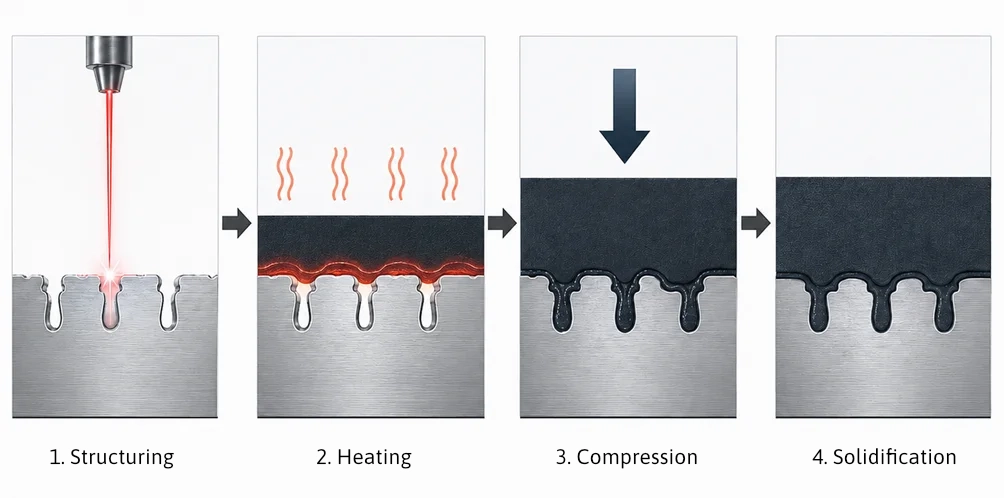
The process can be divided into four steps: structuring, heating, compression, and cooling and solidification. First, the metal joining surface is functionalized using a laser. Next, the metal and thermoplastic are brought into contact. Using laser radiation, induction, heating elements, or another suitable heat source, the interface is heated to the point where the polymer matrix melts locally. Under joining pressure, the melt flows into the laser-generated cavities. When heat input ceases, the joint cools and the thermoplastic solidifies within the structures.
In the case of thermoplastics, it is technically incorrect to speak of chemical “curing.” The strength results from the cooling and solidification of the previously molten polymer matrix. Depending on the material pairing, physical or chemical interactions may also occur at the interface; however, for highly structured surfaces, micromechanical form-fit is a key bonding mechanism.
Why is laser structuring so Crucial?
High surface roughness alone does not guarantee high bond strength. The geometry of the microstructures created is the decisive factor. Typical parameters include structure depth, structure width, pitch, aspect ratio, cavity volume, roughness of the inner walls, and the orientation of the structures relative to the intended direction of loading.
Undercut structures are particularly effective. In this design, an area within the cavity is wider than the opening at the surface. When the thermoplastic flows into this geometry and solidifies there, a mechanical interlock is created. Separation perpendicular to the joint surface then requires deformation or failure of the polymer or the structure itself.
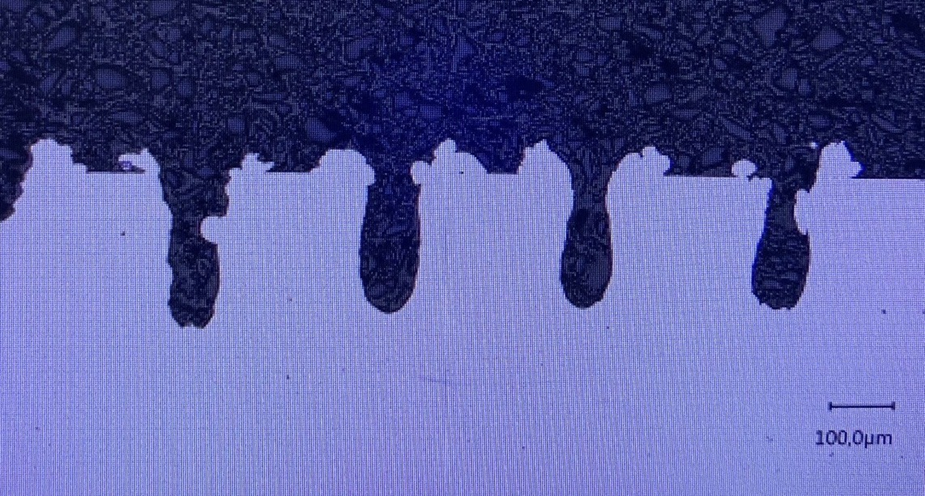
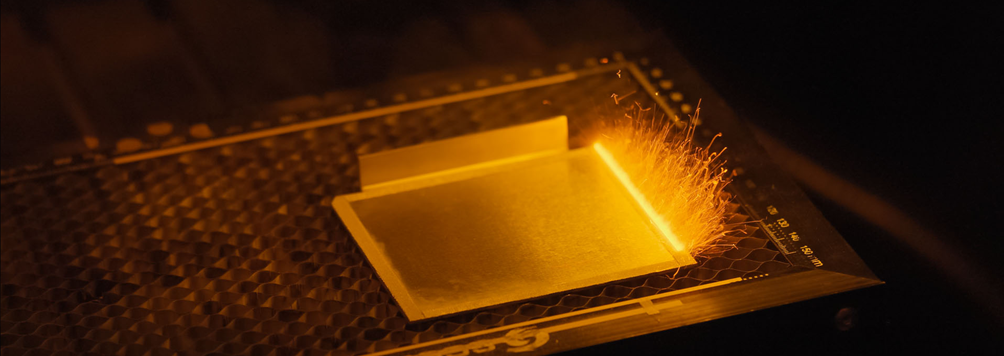
Defined undercuts can also be created using continuous laser radiation. Depending on the structure, significantly higher processing area rates can be achieved with this method. At the same time, it must be understood that structures which are as deep as possible are not automatically better. Reproducibility, uniform undercuts, and complete filling are more important than maximum structure depth.
Temperaturd, Viscosity and joining pressure determine the filling
Even the best laser-generated structure is ineffective if the polymer melt does not completely fill it. Therefore, surface structuring and the thermal joining process must be considered as a single, integrated system.
As the temperature rises, the viscosity of thermoplastic melts decreases significantly. This allows the polymer to penetrate narrow and deep cavities more easily. At the same time, the joining pressure helps force the melt into the structure. The joining time also plays a role: The interface must remain fluid long enough before solidification begins.
Temperatures that are too low result in incomplete melting and poor structural filling. Conversely, excessive heat input or prolonged heating can cause thermal damage to the polymer matrix. Possible consequences include chain scission, gas formation, porosity, or a deterioration in mechanical properties. A material-specific process window comprising temperature, time, and pressure is therefore required to achieve a robust bond.
In the case of fiber-reinforced thermoplastics, there is an additional factor at play. Fine cavities are filled primarily by the molten polymer matrix; depending on their diameter, length, and orientation, reinforcing fibers can penetrate very small structures only to a limited extent. Structures that are too deep can therefore lead to incomplete infiltration or localized fiber damage.
In addition, wetting and interfacial tension influence how well the molten metal penetrates fine structures. At the same time, the metal’s thermal conductivity determines how quickly and uniformly the joining temperature develops. Especially with large metal components, heat dissipation and local temperature gradients can significantly alter the process window. Therefore, temperature measurement, defined contact pressure, and reproducible positioning of the joining partners should be taken into account as early as the equipment and tool design phase and monitored during series production.
Direct Bonding in Injection Molding: an especially series production-ready Alternative
One very attractive option is to insert the laser-structured metal component directly into an injection mold as an insert and then inject the plastic around it. In this case, component manufacturing and the joining process are combined into a single process.
The hot polymer melt comes into direct contact with the textured metal surface and is forced into cavities and undercuts by the injection and holding pressure. As it cools, it solidifies in place, creating a micromechanical form fit. Key process parameters include melt temperature, mold and insert temperature, injection speed, pressure, holding pressure, and texture geometry.
The temperature of the metal insert is particularly important. If the metal is too cold, the polymer melt can solidify immediately at the interface before deep structures are completely filled. With proper process control, however, a high degree of structure filling can be achieved.
This concept is particularly appealing for high-volume production: a separate thermal joining step is no longer necessary, and complex plastic features such as ribs, channels, sealing contours or fasteners can be injection-molded directly onto a metal structural or functional part. Studies on laser-structured metal surfaces in injection molding also show that the diameter, aspect ratio, periodicity, and surface roughness within the cavities all influence the achievable bond strength.
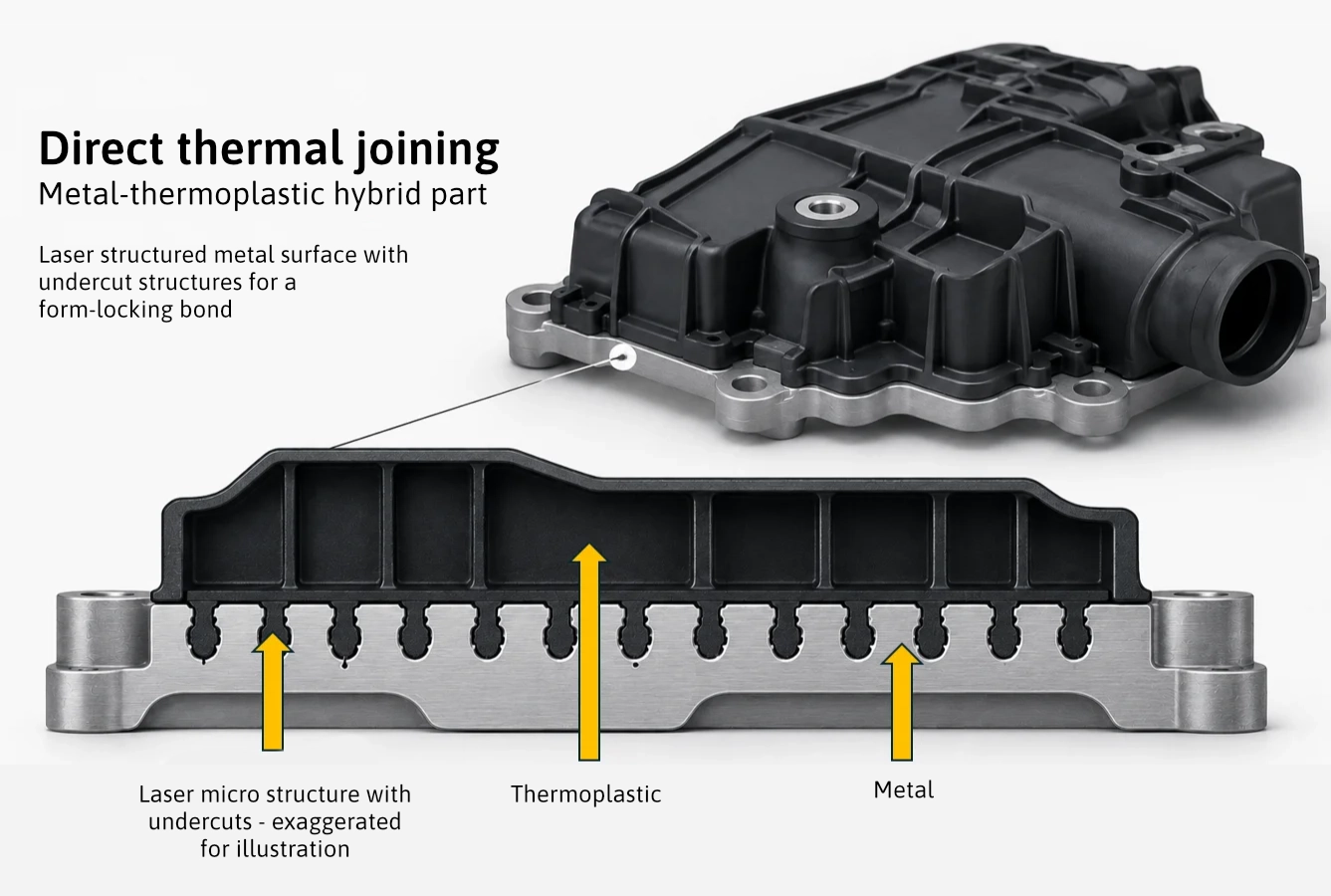
What are the advantages and limitations of direct thermal joining?
Direct thermal joining can replace adhesives, screws, or rivets in suitable applications. This eliminates the need for additional fasteners and, in the case of conventional direct joining, also eliminates long adhesive curing times. At the same time, the laser structure can be created locally and tailored to the load requirements.
Among the most important benefits are:
- Direct bonding of metal and thermoplastics
- Short joining times and high degree of automation
- No traditional adhesive layer required
- High design flexibility for the bonding surface
- Potential for media- or fluid-tight bonds
- Integration into automated manufacturing and injection molding processes
Limitations arise, among other things, from the significantly different coefficients of thermal expansion of metal and plastic. This results in residual stresses during cooling. In addition, long-term behavior, thermal cycling, moisture, contact with media, and fatigue must be tested for the specific application. The component geometry must also allow for access for laser structuring, heating, and joining pressure.
Which material combinations are suitable for direct thermal joining?
In general, direct thermal joining can be implemented with a wide variety of metallic materials and thermoplastics. The key factor is not so much a specific material pairing as it is the coordination of the laser structure, processing temperature, melt viscosity, and thermal properties of the two joining partners.
On the metal side, aluminum and steel varieties are used most often. Depending on the application, magnesium, titanium, or copper alloys may also be selected. Differences in absorption, thermal conductivity, and melting behavior affect both the laser structuring and the temperature distribution during joining.
Thermoplastics are particularly well-suited as polymer partners, since they melt reversibly when heated and can flow into the microstructures that are created. Typical material groups include, for example:
- Polyamide (PA)
- Polybutylene terephthalate(PBT)
- Polypropylene (PP)
- Polycarbonate (PC)
- Polyphenylene sulfide (PPS)
- High-performance thermoplastics such as PEEK
Glass- or carbon-fiber-reinforced thermoplastics are also particularly interesting for direct thermal joining, as they combine high mechanical strength with low weight. However, in the case of very fine laser structures, it must be taken into account that it is primarily the polymer matrix that penetrates the cavities and that the fibers can influence the filling of the structure.
When selecting a suitable combination of materials, the melting and decomposition temperatures of the plastic, the thermal conductivity of the metal, the coefficients of thermal expansion, wetting behavior, and the subsequent mechanical and thermal stresses are particularly important factors.
Thermosetting plastics, on the other hand, are only suitable to a limited extent for conventional direct thermal joining, since they cannot be remelted after curing.
Where is direct thermal joining utilized?
This process is particularly useful when metal is needed only in specific areas to provide strength, stiffness, thermal conductivity, or wear resistance, and the rest of the component is to be constructed from plastic in a way that is optimized for weight or function.
Typische Anwendungsgebiete sind:
- Automotive industry and E-Mobility: Battery components, control unit housings, sensors, pumps, and actuators
- Electronics and power electronics: Housings, cooling structures, and electrically insulating hybrid assemblies
- Lightweight construction and structural components: Metallic load-bearing paths combined with thermoplastic functional structures
- Machinery and equipment manufacturing: Housings, covers, and media-carrying components
- Medical technology: Compact precision components and housings
- Injection-molded hybrid components: Laser-structured metal inserts that are directly co-injected or overmolded
In the field of lightweight automotive construction in particular, concepts close to series production are already being investigated in which laser-structured steel components are bonded to glass-fiber-reinforced thermoplastics as part of an injection molding process.
Conclusion
Direct thermal joining involves more than simply roughening a metal surface and then fusing a plastic to it. Its true performance stems from the precise coordination of the laser structure, temperature field, melt viscosity, joining pressure, and solidification. Structures with undercuts, in particular, enable a strong micromechanical form fit and can improve load-bearing capacity even perpendicular to the joint surface.
For mass production, the combination with injection molding is particularly appealing because manufacturing and joining can be combined into a single process step. In any application where the properties of metal are needed only locally, direct thermal joining thus offers the possibility of combining both material classes in a manner appropriate to their properties to create a lightweight, durable, and functionally integrated hybrid component.


Your Personal Contact Person
Dennis Pechner
Technical Sales Laser Application Center